The Ultimate Guide to Washington Hiking Passes: Which One Do You Actually Need?
If you are new to hiking in Washington, or just visiting the Pacific Northwest for the first time, it will take you about five minutes to realize that our parking pass system is a confusing, bureaucratic puzzle. Welcome to what really is the best summer on earth, where the days are 75 and sunny and everyone is always outside. But if you want to join the crowds on the trails, you need to make sure you have the right passes displayed. Use The Ultimate Guide to Washington Hiking Passes: Which One Do You Actually Need?
To save you the headache (and the ticket), here is a simple, no-nonsense breakdown of the three main hiking passes in Washington, what they cover, and when you can hike for free.
If you are looking for trail inspiration to go with your new passes, check out my guide to the 7 Best Hikes Closest to Seattle or browse my complete log of Hikes I’ve Done (where I track all my Garmin GPS stats). And if you are looking for budget-friendly city activities to pair with your outdoor adventures, don’t miss my summer calendar of Free & Cheap Things to Do in Seattle.
- Is Wizz Air a Real Airline?
- The Ultimate Guide to Washington Hiking Passes: Which One Do You Actually Need?
- 7 Best Hikes Closest to Seattle during FIFA World Cup
- 45 Creative Travel Journaling Prompts
- How to Keep a Travel Journal
Washington Hiking Passes: Master Cheat Sheet
Here is a comprehensive quick-reference table for the most popular trails in Washington. You can find detailed breakdowns of how each pass works directly below this cheat sheet.
| Hike | Region / Corridor | Required Pass | Main Feature & Local Tip |
|---|---|---|---|
| Mount Si | I-90 (Exit 32) | Discover Pass | Steep forest grind with a rocky summit scrambler. |
| Little Si | I-90 (Exit 32) | None (Free) | Shorter, rocky sister trail to Mount Si; parking fills extremely fast. |
| Rattlesnake Ledge | I-90 (Exit 32) | None (Free) | Massive rock outcrop with sweeping lake views. Free parking, but very crowded. |
| Dirty Harry’s Balcony | I-90 (Exit 38) | Discover Pass | Scenic valley views from Exit 38. Great for golden hour. |
| Mailbox Peak | I-90 (Exit 34) | Discover Pass | Famous knee-punishing leg burner. Pick the New Trail for safety, or Old Trail for a steep climb. |
| Twin Falls | I-90 (Exit 34) | None / Discover Pass | Beautiful river trail with bridge views of waterfalls. Park in designated free zones or use Discover Pass. |
| Snow Lake | I-90 (Snoqualmie Pass) | NW Forest Pass / ATB | Stunning alpine lake basin. Extremely popular, requires a federal pass at the Alpental lot. |
| Franklin Falls | I-90 (Snoqualmie Pass) | NW Forest Pass / ATB | Easy, family-friendly walk to a roaring waterfall. Close to the pass. |
| Granite Mountain | I-90 (Exit 47) | NW Forest Pass / ATB | Steep climb to an active fire lookout with panoramic views. |
| Talapus & Olallie Lakes | I-90 (Exit 45) | NW Forest Pass / ATB | Gentle, mossy trail leading to two pristine alpine lakes. |
| Poo Poo Point | Issaquah Alps | None (Free) | Paraglider launch site on Tiger Mountain with views of Lake Sammamish. |
| Wallace Falls | Highway 2 (Gold Bar) | Discover Pass | Multi-tiered rushing waterfalls. Beautifully maintained state park trail. |
| Bridal Veil Falls & Lake Serene | Highway 2 (Index) | NW Forest Pass / ATB | Wooden boardwalks under a massive waterfall wall, leading up to a glacial lake. |
| Heybrook Lookout | Highway 2 (Index) | NW Forest Pass / ATB | Short, steep trail to a tall historic wooden fire lookout tower. |
| Colchuck Lake | Leavenworth (Icicle Creek) | NW Forest Pass / ATB | Famous turquoise glacial lake under Dragontail Peak. Gateway to the Enchantments. |
| Lake 22 | Mountain Loop Hwy | NW Forest Pass / ATB | Classic rainforest trail leading to a dramatic cirque lake. Potholes on the road approach. |
| Heather Lake | Mountain Loop Hwy | NW Forest Pass / ATB | Similar to Lake 22 but shorter and gentler. Also has road potholes. |
| Mount Pilchuck | Mountain Loop Hwy | NW Forest Pass / ATB | Steep rocky scramble to a fire lookout with 360-degree views. Road can be rough. |
| Skyline Trail | Mount Rainier (Paradise) | Rainier National Park Pass / ATB | High-alpine loop with massive glacier views and summer wildflowers. |
| Tolmie Peak Lookout | Mount Rainier (Mowich Lake) | Rainier National Park Pass / ATB | Fire lookout overlooking Eunice Lake and Mount Rainier. Rough dirt road. |
| Naches Peak Loop | Chinook Pass | NW Forest Pass or Rainier NP Pass | Incredible wildflower loop. If parking at Chinook Pass lot (outside park), use NW Forest Pass. |
| Hoh Rain Forest Loop | Olympic National Park | Olympic NP Pass / ATB | World-famous moss-draped old growth forest. Arrive before 9 AM to avoid long lines. |
| Hurricane Hill | Olympic National Park | Olympic NP Pass / ATB | Paved alpine trail with views of the Strait of Juan de Fuca and Canada. |
| Mount Storm King | Olympic National Park (Lake Crescent) | None (Free) | Steep ropes-assisted climb over Lake Crescent. Free park entry since Crescent Lake parking is free. |
| Maple Pass Loop | North Cascades Hwy | NW Forest Pass / ATB | Spectacular autumn larches and ridge views. (North Cascades NP itself has no entry fee, but this trailhead is on USFS land). |
| Diablo Lake | North Cascades Hwy | None (Free) | Scenic lake trail with bright turquoise water. No fee required in the National Recreation Area. |
| Ape Cave | Mount St. Helens | NW Forest Pass / ATB | Two-mile dark lava tube. Requires a federal pass plus a cheap timed reservation ticket in summer. |
The Big Three Washington Passes
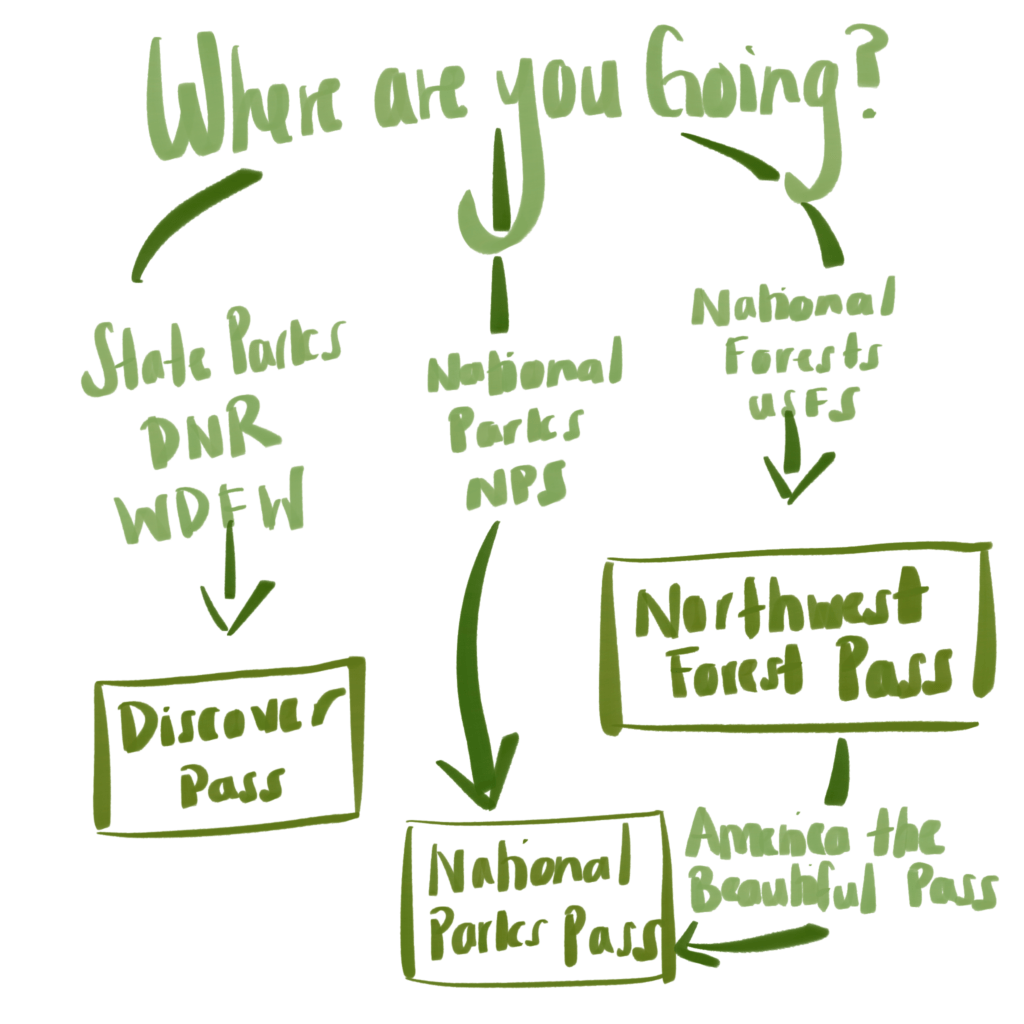
Almost every trailhead in Washington falls under one of three jurisdictions: State, Forest Service, or National Park. Each has its own dedicated pass.
1. The Discover Pass (State Lands)
The Discover Pass is for Washington State recreation lands. If the trailhead is managed by Washington State Parks, the Department of Natural Resources (DNR), or the Washington Department of Fish and Wildlife (WDFW), this is the pass you need.
- Cost: $30 annual pass, or $10 for a single day (plus transaction fees if bought online or at a store, bringing it closer to $35/$11.50).
- Hikes that require it: Mount Si, West Tiger 3, Wallace Falls, and Dirty Harry’s Balcony.
- Key details: The physical annual pass has spaces for two vehicle license plates, so you can share it between two cars. However, you can only use it on one vehicle at a time. It must be clearly displayed on your dashboard or rearview mirror.
Many of the trails that require this pass are excellent after-work options because they are close to the I-90 corridor (so in other words state parks!). Moving from sedentary work to rapidly hiking up a mountain can feel quite intense, but catching a golden hour sunset makes it totally worth it, even if it means a late night for a workday. For example, you can read my first-hand Dirty Harry’s Balcony hike report to see how my friends and I did a late Wednesday evening trek there. And if you make it back to town in time, check out my guide to the best Seattle happy hours in Capitol Hill and the Central District to celebrate.
2. The Northwest Forest Pass (National Forests)
The Northwest Forest Pass is a federal pass specifically for USDA Forest Service recreation sites in Washington and Oregon. If you are hiking in the Cascades or the Olympics outside of the National Parks, you are almost certainly on Forest Service land.
- Cost: $30 annual pass, or $5 for a single day.
- Hikes that require it: Bridal Veil Falls, Granite Mountain, and Talapus & Olallie Lakes.
- Key details: This is a vehicle-based pass. If you have the annual version, it covers parking at all Forest Service trailheads in the PNW.
Many of these trailheads lie along the Scenic Highway 2 corridor or deep in the Snohomish County mountain loops. If you are heading out early to hike Bridal Veil Falls or Lake Serene, note that there is a fun Espresso Chalet near Highway 2 that is a great place to stop before or after an early morning hike.
3. The America the Beautiful Pass (National Parks & Federal Lands)
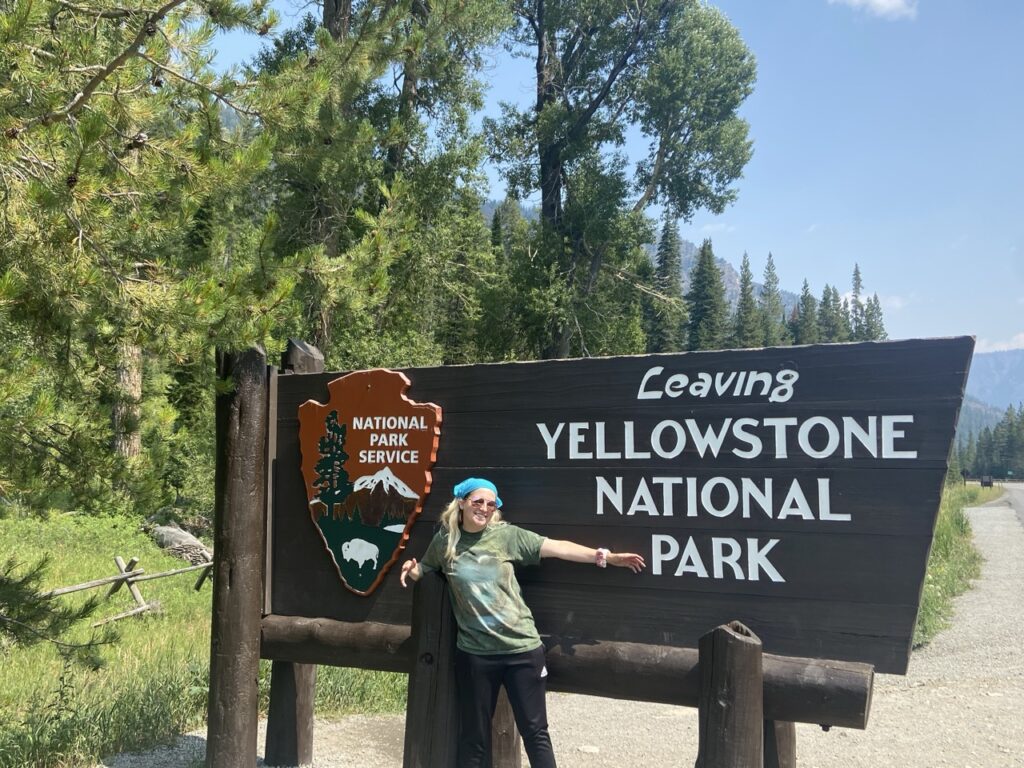
If you plan to visit a National Park (like Mount Rainier or Olympic National Park) or hike frequently in National Forests, the America the Beautiful Interagency Pass is the best investment you can make.
- Cost: $80 annual pass.
- Lands covered: All National Parks (Rainier, Olympic, North Cascades) and all federal recreation sites (including National Forests).
- Key details: This pass completely covers and replaces the Northwest Forest Pass. If you hang this from your rearview mirror, you are good to park at any National Forest trailhead and enter any National Park for a full year.
Note: It does NOT cover state lands, so you still need a Discover Pass for state parks.
Where Can You Hike for Free?
Not every trailhead requires you to pay for parking. Some hikes sit on city, county, or utility lands that do not enforce pass requirements.
- Rattlesnake Ledge: The land is managed by Seattle Public Utilities, and parking at the main lot is completely free.
- Twin Falls: The trailhead sits in a state park boundary but has a designated free parking zone (always check the signs at the trailhead to be safe).
- Little Si: While it sits in the Mount Si NRCA (DNR land), there are occasionally free overflow parking options if you park in designated county areas.
Passes vs. Permits: Don’t Confuse the Two
It is important to remember that a parking pass is not the same thing as a wilderness permit.
A pass allows you to park your car at the trailhead. A permit allows you to camp overnight or climb in restricted areas. For example, if you are doing a day hike to Colchuck Lake, you only need a Northwest Forest Pass to park your car. But if you want to backpack and camp overnight in The Enchantments, you must win a highly competitive overnight permit in the annual lottery.
Always check the Washington Trails Association (WTA) page for your specific hike before you head out to confirm both parking passes and overnight permit requirements.
Happy hiking, and make sure to display that pass on your dashboard! huzzah 🙂